







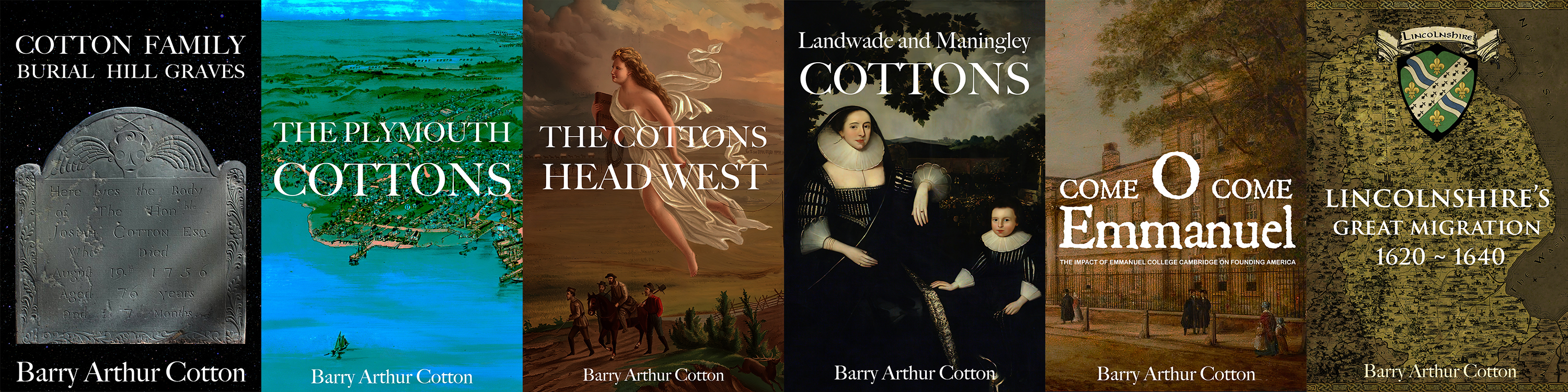












A TALE OF TWO BOSTONS is now available below in three formats.
THE NEW ENGLAND ORIGINS SERIES

The New England Origins Series investigates the English roots of the Anglo-American political, intellectual, religious, and cultural traditions that established New England in North America during the first half of the 17th century.
🔗 View Barry Arthur Cotton’s Amazon Author Page

A Tale of Two Bostons explores the historical significance of Boston, Lincolnshire, and its role in the founding of the Massachusetts Bay Colony. The narrative begins with the political and religious turmoil in England during the early 17th century, when the Forced Loan imposed by Charles I in 1626 led to imprisonment for those who resisted, and highlights the emergence of the Boston Men, who united against Stuart tyranny and formed the Massachusetts Bay Company.
Between 1620 and 1640, the Great Migration saw 20,000 people migrate from England to New England, with 90% occurring after 1630, after William Laud was elevated from Bishop of London to the Archbishop of the English Church.
A Tale of Two Bostons, Barry Arthur Cotton’s first published work, has recently been nominated for the prestigious Eric Hoffer Award for Excellence in Independent Publishing.
Key Figures in the Founding of Massachusetts
The book emphasizes the contributions of lesser-known figures in establishing the Massachusetts Bay Colony.
- Although John Winthrop is often credited as the founder of the Massachusetts Bay Company, Cotton writes that Isaac Johnson, Thomas Dudley, and John Humfrey were the founders.
- The narrative reveals that the Massachusetts Bay Company was established as a for-profit enterprise, countering the myth of purely religious motivations.
The Role of John Cotton
John Cotton’s journey from Cambridge to Boston, Lincolnshire, is a focal point of the narrative.
- Cotton was elected as Boston’s vicar in 1612, despite initial resistance from the Bishop of Lincoln.
- His marriage and subsequent role in the community marked a significant turning point in his life.
- Cotton’s influence extended to the migration of his parishioners to Massachusetts, where he played a pivotal role in the colony’s religious and political life.
The Great Migration and Its Impact
The Great Migration is portrayed as a critical event in American history, with significant implications for both England and the New World.
- 90% of the migration occurred after 1630, driven by religious persecution and political strife.
- The migration represented less than half of one percent of England’s population, yet it had a profound impact on the development of New England.
- The book argues that the contributions of the Boston Men have been largely overlooked in historical narratives.
The Legacy of the Boston Men
The Boston Men are presented as key figures in the establishment of the Massachusetts Bay Company and the colony itself.
- Their resistance to the Forced Loan and subsequent actions laid the groundwork for the colony’s governance.
- The book includes primary documents that illustrate their efforts and the manipulation of royal charters to secure autonomy.
- Despite their significant contributions, the Boston Men remain largely unrecognized in historical accounts of the Massachusetts Bay Colony.
John Cotton’s Academic and Early Life
John Cotton’s academic journey and early career set the foundation for his influential role in the Puritan movement.
- Matriculated as a sizar in 1609 and was awarded a Bachelor of Divinity on July 2, 1613.
- Elected as the schoolmaster of the Free Grammar School of Boston in 1613.
- Assisted in placing students, including Anthony Tuckney and Samuel Whiting, at Cambridge University.
- Married Elizabeth Horrocks on July 3, 1613, marking a significant personal and spiritual milestone.
Cotton’s Marriage and Its Impact
John Cotton’s marriage to Elizabeth Horrocks profoundly influenced his ministry and understanding of spirituality.
- Described his marriage as a “double marriage” to both Elizabeth and Christ, enhancing his spiritual identity.
- His sermons incorporated sexual innuendo and connubial imagery, reflecting a blend of spirituality and sexuality.
- Authored “Milk for Babes,” a catechism that remained in print for over 200 years, emphasizing spiritual nourishment.
Cotton’s Role in Boston’s Community
John Cotton’s pastoral duties allowed him to integrate deeply into the Boston community, shaping his congregation’s life.
- Conducted over 60 baptisms, 30 marriages, and 100 burials in his first year as vicar.
- Baptized and buried several children from the Leverett family, establishing a long-term relationship with them.
- Helped oversee the Boston Grammar School, gaining valuable experience for establishing North America’s first public school in 1635.
Cotton’s Influence on Local Families
John Cotton’s connections with local families, particularly the Hawkreds and Coneys, played a significant role in his community impact.
- Conducted multiple marriages and burials for the Hawkred and Coney families, strengthening ties with influential local families.
- Facilitated the education of young men from these families, including Samuel Coney, who later attended Emmanuel College.
- Married into the Hawkred family in 1632 after the death of his first wife, further solidifying his local connections.
The Rise of Puritanism and Cotton’s Influence
John Cotton’s prominence grew as he became a leading figure in the Puritan movement, advocating for religious reform.
- Attracted attention from Bishop Richard Neile due to his growing popularity and eloquent sermons.
- His sermons, lasting up to six hours, were noted for their depth and theological significance, despite being criticized for containing errors.
- Cotton’s Puritan beliefs emphasized the need for a church free from Catholic influences, aligning with Calvinist principles.
The Forced Loan and Resistance in Boston
The imposition of the Forced Loan in 1626 sparked significant resistance among the Boston community, influenced by Cotton’s teachings.
- The loan prompted a strong reaction from local gentry, who viewed it as an infringement on their rights.
- Cotton’s sermons inspired a sense of righteousness and the desire for a community free from royal intrusion.
- The resistance to the Forced Loan laid the groundwork for the formation of the Massachusetts Bay Company and the eventual settlement in New England.
Lord Saye & Sele’s Influence on Massachusetts Bay Company
Lord Saye & Sele played a crucial role in mentoring key figures and securing a Royal Charter for the Massachusetts Bay Company.
- Mentored Theophilus Clinton, his son-in-law, in the House of Lords.
- Instrumental in manipulating a Royal Charter for the Massachusetts Bay Company.
Lady Arbella Clinton’s Marriage
Familial consent and clandestine arrangements marked Lady Arbella Clinton’s marriage to Isaac Johnson.
- Married Isaac Johnson on April 5, 1623, with consent from her mother and his grandfather.
- The marriage was conducted secretly because of objections from Isaac’s father.
- Samuel Skelton likely officiated the vows at the Earl’s Sempringham estate.
The Friendship of Isaac Johnson and William Blaxton
Isaac Johnson and William Blaxton’s friendship significantly impacted early New England settlements.
- Both completed their education at Emmanuel College and were ordained in 1620.
- Blaxton sailed to Massachusetts in 1623, taking part in the Gorges Expedition.
- Maintained communication with Johnson, offering support during the settlement of Boston.
Lady Susan Clinton’s Marriage and New England Ventures
Challenges and ambitions marked Lady Susan Clinton’s marriage to John Humfrey and their subsequent ventures in New England.
- Likely met Humfrey in 1627; married before December 9, 1630.
- Humfrey was elected Deputy Governor of the Massachusetts Bay Company but later returned to England.
- They settled in Saugus (Lynn) in 1634 but faced hardships, leading to Humfrey’s eventual abandonment of New England.
The Cambridge Agreement and the Massachusetts Bay Company
The Cambridge Agreement was pivotal in transferring governance of the Massachusetts Bay Company to the planters in New England.
- Signed by twelve planters, including Isaac Johnson and John Winthrop, committing to settle in New England.
- The agreement stipulated that governance and the patent must be legally transferred to the settlers.
- Resulted in a significant shift in control from London investors to local settlers.
**Founding of Harvard College
You must be logged in to post a comment.